01 / REVIEW
Start from the approved revision
List the work in the order proposed by the project team. Use actual component names and drawing references. This worksheet records coordination; it does not replace manufacturer instructions or the contractor’s means and methods.
02 / REVIEW
Identify hold points
Before each concealment step, name the condition that needs review and the person responsible. Keep the release decision distinct from a photograph being uploaded. A record received is not automatically a record accepted.
03 / REVIEW
Reopen after changes
If a component, substrate or sequence changes, revisit the affected interfaces. Preserve the prior revision and the reason for the change so the closeout record explains what was actually built.
Test whether the drawing can be assembled
List the order in which the layers are installed, then identify the moment each fixing becomes inaccessible. A detail can be geometrically plausible yet impossible to assemble in the proposed sequence. Bring the relevant trades into the review before the first layer closes access to the next.
Separate temporary support and access from the permanent assembly. The drawing should not imply that an unsupported part remains in place while another trade completes hidden work.
Write a sequence with hold points
Scroll sideways to read all columns. Keyboard: focus the table and use the arrow keys.
| Stage | Question before proceeding |
|---|---|
| Prepare support | Is the accepted substrate present and ready? |
| Install concealed layer | What must be inspected or documented now? |
| Fit attachment | Can the specified tools reach the fixing? |
| Close with wood | Which earlier checks must be complete? |
| Finish and hand over | How will the next person inspect or remove it? |
For a fictional corner, fitting both finished faces first blocks access to the final attachment. The solution needs an accepted sequence or revised detail. Simply adding another fastener in a convenient place would create an undocumented change.
Retain sequence notes with the drawing revision. If a substitution changes tool access or assembly order, reopen the affected hold point even when the finished appearance remains similar.
Make each handoff a decision, not a diary entry
“Flashing complete” describes activity, but it does not tell the next trade whether the junction is ready to cover. A useful handoff names the exact location, the drawing revision used, what remains visible, what evidence was reviewed and who can release the next step. Keep the installing party and the release authority distinct when the project assigns those roles separately.
Use plain status labels. Installed means the work is reported in place. Evidence received means the record is available for review. Released to conceal means the person assigned that decision has recorded a release for the stated scope. None of these labels should silently stand in for the others. If your project uses different terms, write down their meaning before work begins.
Scroll sideways to read all columns. Keyboard: focus the table and use the arrow keys.
| Record field | What to enter |
|---|---|
| Interface and location | A stable identifier, elevation or room, and limits of the reviewed work |
| Drawing basis | Detail number and revision; identify any accepted clarification |
| Work ready for review | The components actually installed and still accessible |
| Evidence | Oriented photographs, relevant measurements and document references |
| Unresolved item | The specific question, responsible person and required response |
| Release | Decision, named authority, date and the exact next activity permitted |
A release for one opening should not automatically release every similar opening. Record whether the review covers a single location, a defined group or a representative mockup, and who established that scope. This suggested record structure is a coordination aid, not a prescribed inspection procedure.
Worked example: trim arrives before the head review
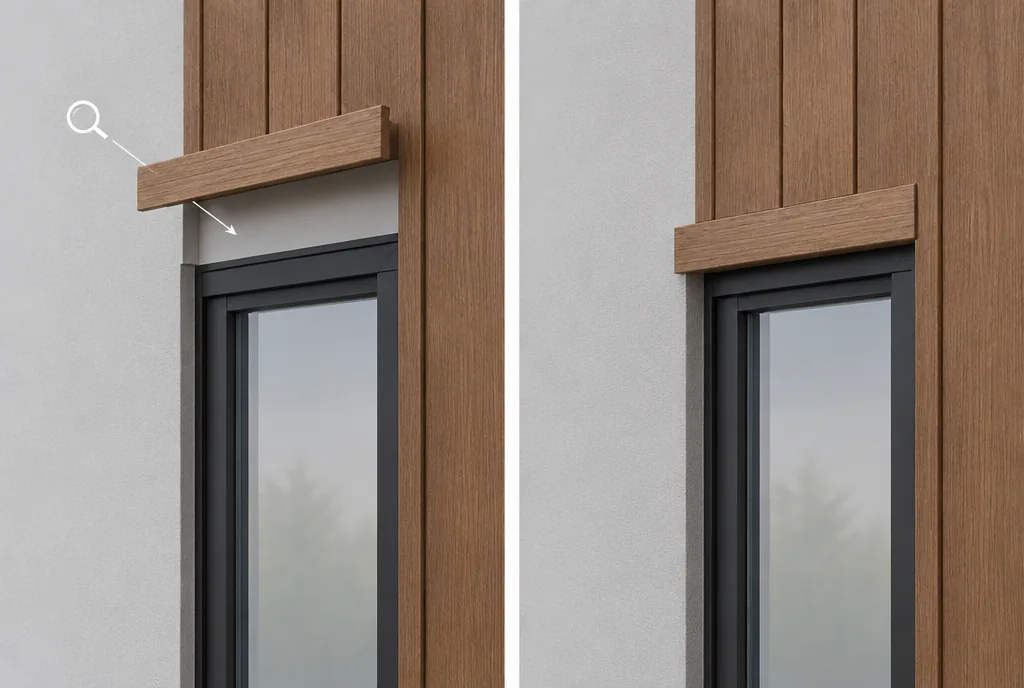
Consider a fictional wood-clad opening identified as H-07. The current coordinated drawing is detail 5 on revision C. The cladding team proposes fitting the visible head trim on Tuesday. The planned review of the concealed head transition is Wednesday. Fitting the trim first would prevent the reviewer from seeing the junction. The problem is a sequencing conflict even if the trim itself matches the approved appearance.
Scroll sideways to read all columns. Keyboard: focus the table and use the arrow keys.
| Stage in this example | Recorded decision |
|---|---|
| Before trim installation | H-07 remains open. Identify the concealed junction and the review evidence required. |
| Photographs received | Mark evidence received, not released. Confirm the photographs show H-07 and revision C work. |
| Question still open | A return at the end of the junction is not visible in the record. Ask for a view or clarification that resolves that question. |
| Review completed | The assigned authority records the decision and limits. If released, identify the trim work allowed to proceed. |
| After concealment | Keep the release, photographs and final location together; do not replace them with a finished-face photograph. |
The example deliberately supplies no flashing size, lap, fastener spacing or sealant specification. Those belong to the actual coordinated assembly. Its lesson is the relationship between access, evidence and the next activity. Rescheduling the review may resolve the conflict; a detail revision may be needed if the work cannot be inspected or assembled as proposed. The project team decides which response is appropriate.
Reopen only the affected work, but trace every dependency
A late change can leave the finished elevation looking the same while changing concealed access. Examples include a deeper trim return, a different attachment requiring another tool approach, or a penetration moved into the planned fixing zone. Record what changed and which earlier decisions relied on the old condition.
Start with the interface identifier. Trace the change through adjacent components, access for installation, access for review and access for later replacement. The aim is not to restart every review indiscriminately. It is to avoid carrying an earlier release forward when its underlying conditions no longer apply.
- Retain the superseded drawing and mark which revision replaces it.
- Identify installed work affected by the change separately from work not yet started.
- Assign the unresolved question to the person authorized to resolve it.
- State whether an earlier release remains valid, is limited, or needs a new decision.
- Link the final response to the physical location and the record used by the next trade.
For example, replacing a removable cover with a fixed trim may leave the initial installation sequence unchanged but defeat the intended repair access. That belongs in the repair-access review as well as the sequence record. Do not describe the detail as maintainable simply because the first installation was possible.
Keep the closeout record usable after the team leaves
A folder of unnamed close-up photographs is difficult to use months later. Begin each location record with an overview that identifies the interface, then add the views needed to understand the concealed relationship. Retain the original files and connect each to the relevant detail and revision. If a photograph was taken before a correction, label that fact; do not leave it looking like the final condition.
The final record should let a new reviewer answer four questions: where is this junction, which detail governed it, what decision allowed it to be covered, and what changed afterward? A missing answer should remain visible as an open record item rather than being filled with a retrospective assumption.
Before handover, sample a completed record from start to finish. Follow its identifier from the elevation to the drawing, evidence, review response and final location. If the chain breaks, repair the record while the participants can still explain it. The concealed-work guide covers the evidence to preserve; the interface inventory provides the location structure. Neither substitutes for the project’s required inspections or approvals.
A junction coordination study
Concept example: trim installation is moved earlier. The planned cavity inspection would no longer be possible. The hold point is rescheduled before the trim closes the view.
Use the result
Keep the completed review with the relevant project record. Assign unresolved items before relying on a conclusion. If the material, condition or document changes, revisit the affected questions.
Assembly explorerTechnical references
General background for the subject. Project worksheets and fictional situations are original review aids, not official agency forms.